Thursday, 5 November 2015

Year 6 get a little hot under the collar

6S were working with their Bunsen burners in the lab this morning
They heated a variety of substances and looked for physical and chemical changes 
 first was ice
ice, ice, baby 
to water and steam (physical change)
then paper 
which burned (definitely chemical)
Tin foil was interesting 
 it depended how hot it was and whether it could react with oxygen from the air
 when hot enough it was a chemical change
but at lower temperatures it only changed physically 


Finally wood and another definite chemical change 
Some very good observations were made today

7C learn all about the base

7C did a neutralisation expetriment today
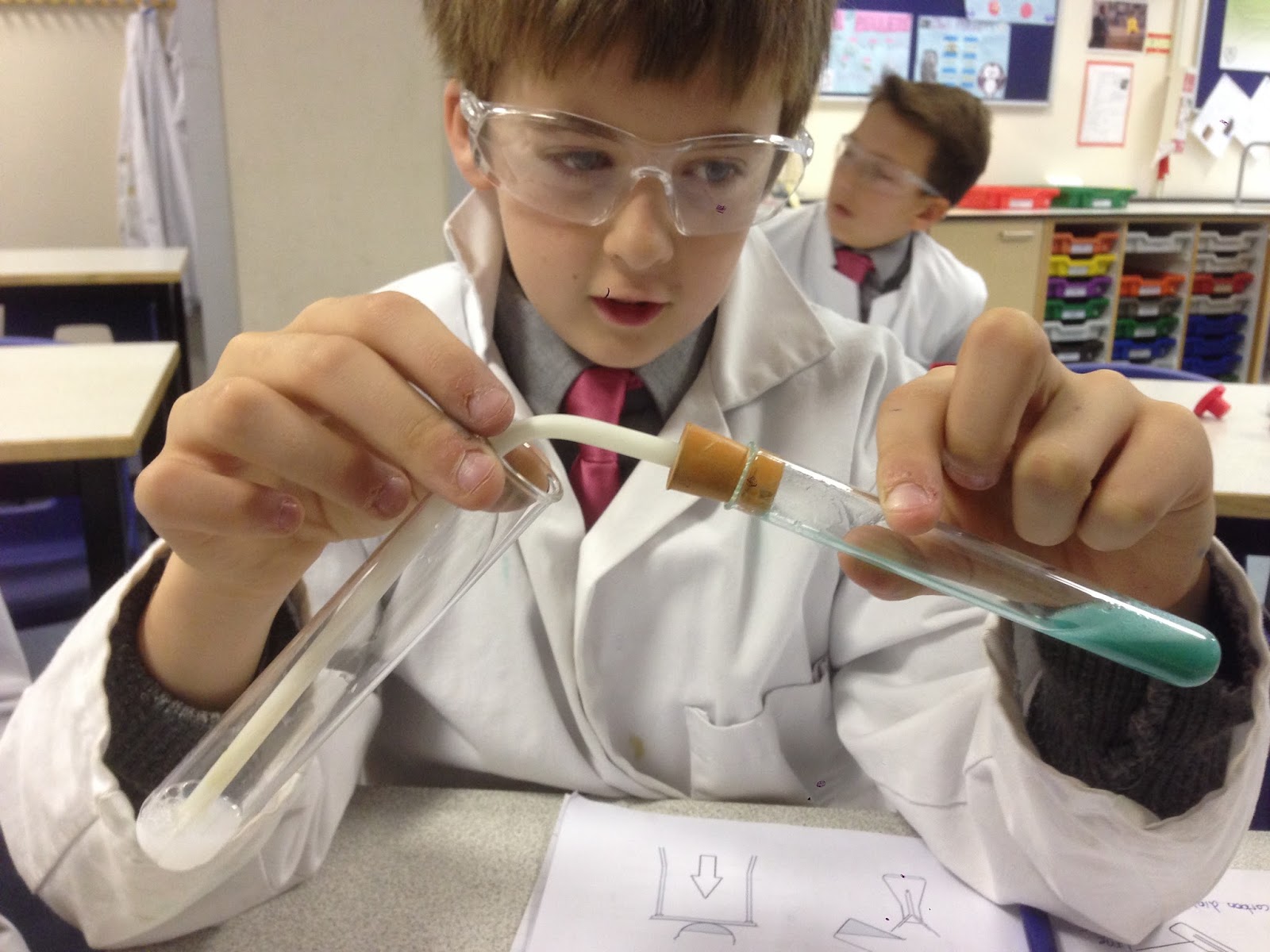
They assembled their equipment and loaded the test tube with copper carbonate. 
 Sulphuric acid was added and a delivery tube was positioned to pass the gas evolved into limewater
 The lime water went cloudy showing that carbon dioxide was produced
 There was a blue solution produced
 after a few more pippettes of sulphuric acid much of the green copper carbonate had gone
The bits that were left were filtered out
 
The the filtrate was heated in an evaporating basin 
the solvent evaporated and the solute started to crystalise 
Soon blue crystals of copper sulphate were formed 
 Most of the hot solution was collected and left in a crystalising basin so large crystals can form.

Wednesday, 4 November 2015

Year 7 concentrate

Year 7 have been learning about concentration this week. They were presented with two acids and told they had different concentrations. They had to find out which acid, A or B, was the most concentrated.


They started by measuring 10ml of acid and adding universal indicator. 


They then slowly poured an alkali into their mixture and measured how much they had to add to turn the solution neutral. 


The acid that required the most alkali was the most concentrated. It meant that were more acid molecules to be neutralised. 


Its all about the Base

But these are chemical bases.
We are using copper carbonate to neutralise sulphuric acid.
The reaction produces carbon dioxide which we test with limewater
 The blue solution that is made has bits of unreacted green copper carbonate in it
 We have made lots of copper sulphate solution too
 We need to separate them by filtration
 the residue is the insoluble copper carbonate
 We heat the filtrate, copper sulphate solution, to evaporate the solvent, water, and leave us with the solute, copper sulphate crystals.

Wednesday, 21 October 2015

Team Wybar vs Team Purcell

This morning two of our Year 7 classes had a competition over which type of indigestion medicine was the best - tablets/powder or liquids. They have been learning about neutralisation in their recent Science lessons and looking at how these medicines would neutralise excess stomach acid.

First a team captain was chosen from each class. The captains had to pick which type of medicine they would be testing. 

Team Purcell got liquid medicines:

With Team Wybar selecting tablets/powders:


Then the teams separated to get down to work.

Each group carefully measured one maximum adult dose of thier medicine using a number of techniques such as measuring cylinders, teaspoons, scales and those who had large tablets crushed the medicine in a pestle and mortar before dissolving it in warm water. 


Then they started to add acid to the medicine, checking the pH at regular intervals. 


The medicine which would neutralise the most acid was the most effective. We also compared the price of the different medicines. 

The two teams met again at the end of the lesson to reveal their results. The atmosphere was tense.....


The medicine that could neutralise the most acid was also the cheapest medicine that we tested. It was the Sodium bicarbonate powder. Well done to both classes for some great scientific skills and congratulations to Team Wybar for their victory.